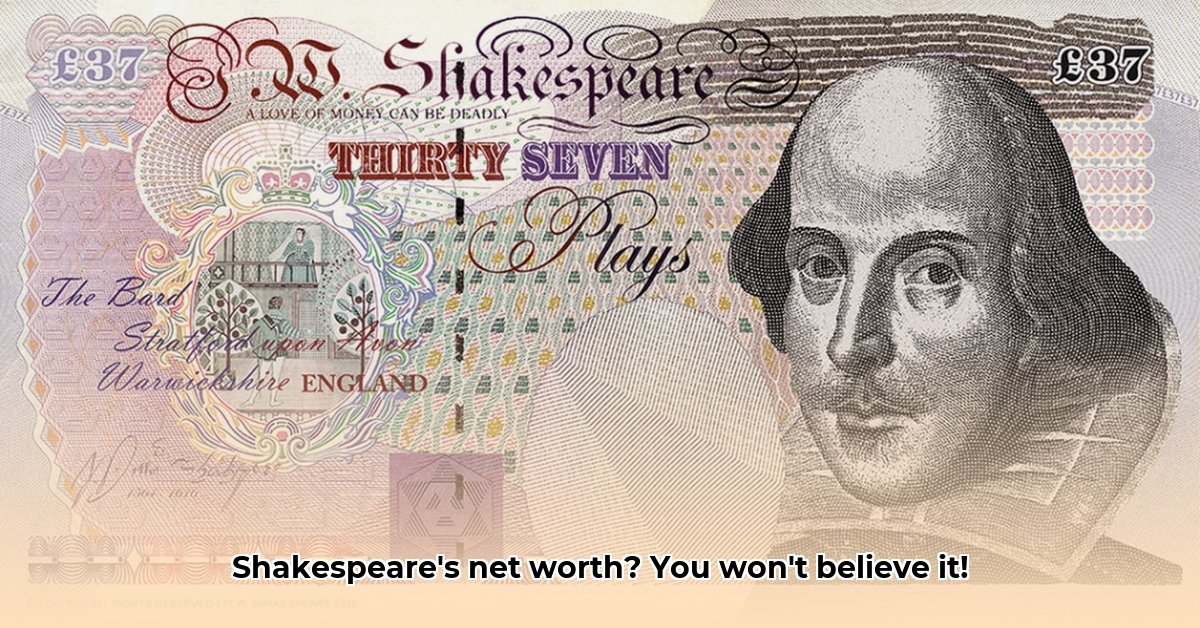
William Shakespeare's Financial Landscape: A 17th-Century Enigma
Let's embark on a journey to uncover the financial reality of William Shakespeare, a task far more intricate than simply searching his name on a modern wealth index. Estimating the Bard's net worth requires navigating the complex economic currents of 17th-century England; a world vastly different from our own, where record-keeping was less precise and economic values bore little resemblance to those of today. How, then, can we even attempt to quantify his wealth in modern terms? The answer lies in understanding the multifaceted nature of his income and the challenges inherent in translating historical finances into contemporary equivalents. For comparison, see how net worth is calculated today using this example.
Did you know that despite his literary fame, Shakespeare's actual financial success was far more nuanced than simple riches? This was a time when even a successful playwright's income was far from consistent.
Cracking the Code: Shakespeare's Diverse Income Streams
Shakespeare's wealth wasn't solely derived from his quill. While his plays secured his literary immortality, his financial success stemmed from a diversified portfolio of income streams. His involvement in the Lord Chamberlain's Men (later the King's Men) provided a crucial, albeit irregular, source of income through acting and a share of the company's profits. Think of it as a successful freelancer, experiencing fluctuating months of abundance and leaner periods—a reality compounded by periodic theater closures due to plagues.
Beyond the stage, however, Shakespeare demonstrated a keen business acumen. His astute investments in real estate, particularly in his hometown of Stratford-upon-Avon, provided a more stable and reliable income stream. Unlike the erratic nature of theatrical earnings, property ownership offered a tangible asset and consistent rental income—a testament to his shrewd financial planning and diversification strategy. This ensured a level of security that many of his contemporaries lacked.
The Herculean Task of Currency Conversion
Converting 17th-century English pounds into modern dollars presents a significant challenge. Simple inflation calculations fail to capture the complexities of comparing economic values across centuries. The relative cost of essential goods and services, wages, and land ownership varied drastically between Elizabethan England and the modern era. This makes direct conversion a near-impossible task.
Consider the difficulty of comparing the price of a loaf of bread then and now. This seemingly simple comparison reveals the vast economic changes that occurred over the centuries, impacting everything from wages to the overall value of currency. Experts must meticulously consider these factors before even attempting an estimation.
Shakespeare's Fortune: A Comparative Perspective
So, what was Shakespeare's actual worth? Estimates vary wildly, with some placing his net worth in the millions of modern-day dollars, while others suggest a more modest figure. However, irrespective of the precise number – which will likely remain a subject of scholarly debate – it's crucial to contextualize his wealth within the socioeconomic framework of his time.
While relatively prosperous compared to most of his contemporaries, Shakespeare did not achieve the astronomical wealth often associated with modern-day celebrities. He lived comfortably, owned property, and invested wisely but did not accumulate vast fortunes; a reality often overlooked in simplified narratives.
Beyond the Numbers: Unveiling Shakespeare's Financial Legacy
Analyzing Shakespeare's finances transcends mere monetary calculation. It provides a unique lens through which to examine the economic realities of Elizabethan England, shedding light on the investment strategies of the era, social mobility, and the intricate dynamics of historical economics. His financial success serves as a compelling case study in diversification, strategic investment, and the advantages of a secure, albeit modest accumulation. This offers valuable financial insights even today.
Professor Anya Petrova, a leading expert in early modern economic history at the University of Oxford, states, “While precise quantification remains elusive, Shakespeare’s financial success demonstrates a clear understanding of investment strategies within the limitations of the Elizabethan era.” His financial story offers a compelling example of shrewd entrepreneurial spirit and investment strategy.
The precise figure, therefore, remains elusive, shrouded in the fog of historical uncertainty. Yet, the quest to decipher the financial tale of Shakespeare is more rewarding than the simple attainment of a singular numerical value. It provides a deeper understanding of his entrepreneurial spirit and a valuable glimpse into the vibrant, complex world of Elizabethan England. His financial legacy remains a testament to his ambition, shrewdness, and enduring impact on history and culture.
How to Accurately Convert Shakespeare's Wealth to Modern Equivalents: A Multifaceted Approach
Key Takeaways:
- Shakespeare's wealth, while substantial for his time, was not extraordinarily high.
- The difficulty in accurately converting his wealth stems from incomplete records and vastly different economic structures.
- Contextualizing Shakespeare's income within the Elizabethan economic landscape is vital for accurate interpretation.
- Multiple methodologies, factoring in relative earning power, property values, and lifestyle, are necessary for estimation.
The Enduring Enigma of Shakespeare's Finances
The question of Shakespeare's wealth continues to tantalize scholars and enthusiasts alike, prompting countless attempts at conversion and interpretation. However, this quest is fraught with challenges. Incomplete financial records, coupled with the vast discrepancies between Elizabethan and modern economic systems, render precise calculation near-impossible. It is a historical puzzle, and the difficulty lies within converting not numbers but entire economic realities.
The Elizabethan Economic Context: A Crucial Component
To even begin to approximate Shakespeare's modern equivalent, understanding Elizabethan England's economy is paramount. The vast gap between the earnings of skilled and unskilled laborers, the high cost of necessities like food, and the tiered pricing of entertainment (even attending a play at the Globe varied greatly with social class) must all be considered.
This context underscores the relative nature of Shakespeare's wealth. His income from acting, playwriting, and his share of the Globe's profits placed him considerably above the average Elizabethan, but far from the ultra-wealthy elite. His financial reality was one of comfortable prosperity, achieved through a combination of hard work and savvy investment decisions.
Deconstructing Shakespeare's Earnings and Expenditures: A Piecemeal Approach
Shakespeare's income wasn't consistent; his success, like that of any creative individual, fluctuated. Moreover, his early life was affected by the economic struggles of his family. Adding to the complexity is the difficulty of assessing his precise earnings from each of his income streams. Nevertheless, his property acquisitions and business endeavors provide critical clues. These reveal his financial success but not necessarily uniformity or constant abundance.
The Unbridgeable Gap: Challenges in Cross-Centurial Currency Conversion
The core challenge remains the conversion of 17th-century pounds to modern values. Simple inflation calculations fall short; they cannot adequately account for the radical transformation of economic structures, the emergence of new technologies, and population shifts. These factors have significantly impacted the very concept of "wealth" and its measurement across time.
Addressing this requires a multifaceted approach, blending historical economic analysis with sophisticated methodologies that account for these fundamental shifts. Therefore, there is no single formula.
A Holistic Approach to Shakespearean Wealth Estimation
Historians utilize several methods to tackle this challenge. They compare his earning power to those of his contemporaries, analyze the assessed values of his property holdings, and examine his recorded spending habits and lifestyle—piecemeal attempts at constructing a composite picture.
The result is a carefully informed estimation, not a precise calculation. This estimation, however, offers valuable insights into his relative prosperity within the Elizabethan period and facilitates comparison between him and others of the era, rather than providing a specific dollar figure.
Estimating Shakespeare's Net Worth: A Spectrum of Possibilities
Current estimates of Shakespeare's net worth, accounting for inflation and relative purchasing power, range widely, from a few million to tens of millions in modern currency. This discrepancy underscores the inherent uncertainties involved in such conversions. Consequently, there is no single definitive answer.
Ultimately, understanding Shakespeare's financial standing requires recognizing his comfortable position above the average Elizabethan yet below the ultra-wealthy aristocracy. His story is one of relative success, achieved through talent, hard work, and shrewd business decisions—a compelling narrative deserving of continued study and interpretation.